
Subtitle: Just a Mouth Ulcer? Beware of Hidden Cancer
Warning Signs
Have you ever experienced this? After working late or
eating spicy hotpot, a painful ulcer develops in your mouth the next day,
making it unbearable even to drink water or swallow. Most people assume it is
just a common symptom of "excessive body heat" that will resolve with
some oral gel or by drinking more water. However, if this ulcer persists in
your mouth for more than two weeks without healing, or if it feels firm to the
touch, it may not be a simple sore—it could be an early warning sign of oral
cancer.
Oral cancer ranks among the top malignancies among men
in Taiwan, posing a severe threat to families and personal health. Many
individuals delay seeking medical attention until the tumor grows larger,
affecting their swallowing or speech, either out of fear of examination or
because they overlook the initial symptoms. In fact, early oral lesions are
highly detectable with the naked eye. With early diagnosis and proper
treatment, the cure and survival rates for early-stage oral cancer are
remarkably high.
Why Does Oral Cancer Occur? Understanding Common Risk
Factors and Mucosal Changes
Oral cancer does not develop overnight; rather, it
results from chronic irritation of the oral mucosa by external substances. In
Taiwan, the most common catalysts driving the "oral cancer trilogy"
are betel nut chewing, cigarette smoking, and excessive alcohol consumption.
These three habits exert a synergistic effect; individuals who engage in all
three simultaneously face an oral cancer risk over a hundred times higher than
average. Additionally, chronic friction caused by poorly fitting dentures is
another common causative factor observed in clinical practice.
Before progressing to full-blown cancer, the oral
mucosa typically exhibits "precancerous lesions." These changes
include persistent white or red patches (leukoplakia or erythroplakia) that
cannot be rubbed off, or a stiffening of the oral mucosa that limits mouth
opening. Because these mucosal abnormalities are often completely painless,
they are difficult for the general public to notice on their own. Only through
professional visual inspections and palpation by a physician can these changes
be detected early, allowing medical intervention to step on the brakes before
the mucosal cells completely turn malignant.
The Key to Cancer Prevention: Take Advantage of Free
"Oral Mucosal Examinations" and Join the "Check & Win"
Campaign
What is the most effective weapon against oral cancer?
It is undergoing regular "oral mucosal examinations." This is a very
simple, fast, and completely painless check-up. The doctor takes just a few
minutes to carefully examine your buccal mucosa, tongue, gums, and the floor of
your mouth, looking for any abnormal colorations or lumps. To protect public
health, the government subsidies free oral mucosal examinations once every two
years for eligible high-risk individuals.
To encourage more eligible individuals to step forward
and protect themselves, our hospital is fully cooperating with national cancer
prevention policies to launch the "Check & Win" campaign! If you
qualify for the screening, simply come to our hospital to complete a quick oral
mucosal examination, and you will get a chance to enter a lucky draw and win
great prizes. Screening not only brings peace of mind but also helps you win
the upper hand in managing your health.
"Check & Win" Free Screening Eligibility:
l
Individuals aged 30 or above who currently
smoke or chew betel nuts (including those who have quit): Eligible once every 2
years.
l
Indigenous individuals aged 18 to 29 who
currently chew betel nuts (including those who have quit): Eligible once every
2 years.

(Image Caption: Far Eastern Memorial Hospital provides
a convenient oral mucosal examination service that takes only 2 minutes, is
painless, and is safe. If you have a smoking or betel nut chewing habit, come
join our Check & Win campaign to win a healthier future.)
3 Key Lifestyle Tips to Stay Far Away from Oral Cancer
In addition to relying on regular screenings,
establishing healthy daily habits is the ultimate way to prevent oral cancer.
Doctors recommend starting with these three major approaches:
l
Steer Clear of Carcinogens (Say No to
Tobacco, Betel Nuts, and Alcohol): Quitting betel nuts and smoking is the most
direct way to protect your oral mucosa. If you find it difficult to quit on
your own, you can seek assistance from our hospital's specialized smoking and
betel nut cessation counseling clinics.
l
Watch Out for Chronic Oral Friction: If
you wear dentures and notice they are loose, damaged, or frequently scratch
your gums or cheek lining, see your dentist immediately for adjustments to
prevent the mucosa from being in a state of chronic inflammation.
l
Increase Intake of Fresh Fruits and
Vegetables: Foods rich in Vitamin C and antioxidants help repair damaged
mucosal cells and boost your overall immune system.
Hospital Highlights: FEMH Cross-Disciplinary
Integrated Care, Standing as Your Ultimate Health Shield
As a leading medical center in New Taipei City, Far
Eastern Memorial Hospital possesses top-tier expertise and extensive experience
in oral cancer prevention, screening, and treatment. We have established a
streamlined "green channel" referral system. If any suspicious lesion
is detected during an oral mucosal examination, the patient can be immediately
referred to the Department of Otolaryngology or Oral and Maxillofacial Surgery
for a biopsy. This one-stop service relieves patients of the anxiety of
repeatedly booking appointments and waiting in lines.
For confirmed cases, our hospital boasts a dedicated
"Head and Neck Cancer Multidisciplinary Team" comprising experts from
Otolaryngology, Oral Surgery, Medical Oncology, Radiation Oncology, and Plastic
Surgery. We tailor the most appropriate treatment strategy for each patient.
Beyond pursuing a complete cure for cancer, we place great emphasis on
post-operative minimally invasive reconstruction and swallowing rehabilitation,
aiming to preserve our patients' appearance and quality of life to the greatest
extent possible.
FAQ: Master Your Oral Health in Seconds
Q1: I quit chewing betel nuts several years ago. Do I
still need an "oral mucosal examination"?
A1: Yes, absolutely! The cellular damage caused by
chewing betel nuts accumulates over time, meaning the risk of mucosal lesions
persists even after you stop. Therefore, eligible individuals should still
undergo regular screening every 2 years.
Q2: Does an oral mucosal examination hurt? Do I need a
blood test or an X-ray?
A2: It is completely painless. An oral mucosal
examination involves a physician visually inspecting and gently palpating the
inside of your mouth. It requires no blood draws and involves no radiation,
making it a very quick and comfortable process.
Q3: If my screening shows "white patches" or
"red patches," does it mean I definitely have oral cancer?
A3: Not necessarily. White patches (leukoplakia) or
red patches (erythroplakia) are classified as "precancerous lesions."
This means the cells have begun to show abnormalities but have not yet turned
into cancer. At this stage, following your doctor's advice for regular
follow-ups, or receiving simple laser therapy or localized excision, can
effectively stop the condition from progressing into oral cancer.
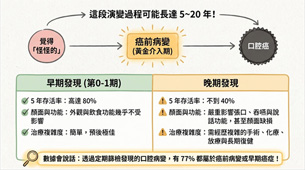
(Image Caption: Early detection helps win back your
health! The progression of oral cancer can take 5 to 20 years. Clinical data
proves that up to 77% of lesions found through regular oral mucosal screening
are precancerous or early-stage cancer, with early-stage cure rates exceeding
80%.)
References
l
Sung, H., Ferlay, J., Siegel, R. L.,
Laversanne, M., Soerjomataram, I., Jemal, A., & Bray, F. (2021). Global
cancer statistics 2020: GLOBOCAN estimates of incidence and mortality worldwide
for 36 cancers in 185 countries. CA: A Cancer Journal for Clinicians, 71(3),
209-249.
l
Johnson, D. E., Burtness, B., Leemans, C.
R., Lui, V. W. Y., Bauman, J. E., & Grandis, J. R. (2020). Head and neck
squamous cell carcinoma. Nature Reviews Disease Primers, 6(1), 92.