Say Goodbye to Keloid Troubles: Expert Radiotherapy Team Offers Solutions What Are Keloids?
Radiation Oncology Dr. Guo Dengyu

Specialties: Radiotherapy, various cancer radiotherapy, navigation spiral knife, stereotactic radiotherapy, stereotactic radiosurgery
Keloid formation is influenced by a
combination of factors, including genetic predisposition, wound healing
conditions, and local skin tension. Individuals with darker skin tones are more
susceptible to developing keloids.
This condition is not just a cosmetic
issue—it often brings discomfort, such as itching and pain. In some cases,
keloids can lead to functional problems. When formed near joints, they may
restrict movement, significantly affecting a person’s quality of life.
Keloids and Radiotherapy
Radiotherapy is widely used for cancer
treatment, but it is also effective for benign conditions like keloids,
especially for preventing fibroblast reactivation after surgery. Studies have
shown that 1 to 3 sessions of postoperative radiotherapy can significantly
reduce the risk of recurrence.
For patients who are not suitable
candidates for surgery or who have concerns about surgical procedures,
radiotherapy offers an effective alternative. Using external X-ray treatment
combined with image-guided techniques, radiotherapy can precisely target the
affected area, effectively alleviating symptoms such as pain, itching, and
irritation.
Mechanisms of Radiotherapy:
- Inhibits fibroblast proliferation and growth
- Reduces excessive collagen production
- Improves local blood flow and promotes tissue repair balanceRadiotherapy Techniques
The Division of Radiation Oncology at Far Eastern Memorial Hospital has extensive experience in treating keloids and has continuously optimized treatment techniques through clinical research to address the specific needs of different lesions and patients.
Technique | Electron Beam Therapy | External X-ray Therapy | Brachytherapy |
Description | Shallow radiation with an energy range of 6 to 9 MeV | High-energy X-rays generated by a linear accelerator | Radiation source (e.g., Ir-192) used for short-distance treatment |
Advantages | Radiation dose is concentrated on superficial lesions, especially suitable for lesions less than 2 cm in thickness. | Uniform dose distribution, not limited by surface shape, ideal for treating complex lesions. Can be combined with image-guided techniques to reduce radiation exposure to surrounding healthy tissue. | Radiation dose is concentrated on the lesion's surface, with rapid dose attenuation, making it ideal for uneven or irregular surfaces. |
Disadvantages | Electron beams scatter, which may cause uneven dose distribution on uneven surfaces. | X-rays penetrate deeper, and some radiation may affect deeper tissues nearby. | Caution is needed for thicker lesions to avoid excessive surface dose that may lead to side effects. |
Consultation and Contact
For more information on keloid treatment, feel free to contact the Plastic and Reconstructive Surgery Division or the Radiation Oncology Division for consultations. You can also join the official LINE account of the Far Eastern Memorial Hospital Keloid Treatment Team to receive professional advice and the latest updates.
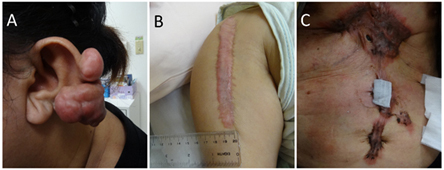
Figures: keloid occurrence in different locations: (a) earlobe, (b) shoulder, (c) chest and abdomen.