
With the rapid development of medical
technology and the challenges of the post-pandemic era, medical education is
facing a major transformation. The traditional apprenticeship system is no
longer sufficient to cope with the highly complex clinical environment. Our
hospital deeply understands that talent cultivation is the foundation of
medical quality. In recent years, we have actively promoted "Smart
Technology × Educational Innovation," with a "high-value medical
education model" at its core. Through digital transformation, AI, and
immersive technologies, we are reconstructing the teaching environment to
enable faster, broader, and more accurate experience transfer, and to cultivate
a new generation of medical professionals with resilience and forward-looking
vision while ensuring patient safety.
I.
Process Innovation: From Digital Transformation to Efficient Paperless
Management
Educational reform must begin
with the digitization of administrative processes. In the past, paper-based
assessments and cumbersome administrative procedures were not only
time-consuming but also made it difficult to accumulate and analyze teaching
data. Our Department of Teaching has adopted tools such as Microsoft 365 to
promote process reengineering and paperless processes, enabling the integration
and visualization of fragmented information, improving decision-making
efficiency and the ability to track improvement solutions.
The establishment of the
"Electronic Learning Passport" and the "Digital Course
System" creates a personalized learning database for each student,
comprehensively recording attendance, course participation, and clinical
performance. Combined with the principles of Competency-Based Medical Education
(CBME), this data-driven approach enables individualized learning plans. This
process optimization integrates the learning process, competency assessment,
and administrative management, forming a smart teaching management ecosystem.
II.
Intelligent Upgrade of Knowledge and Skills: Gen AI and Intelligent Chief
Physician
In terms of knowledge transfer
and clinical support, the application of generative AI has opened up new
possibilities. Our hospital is actively exploring the use of GenAI to build a
national examination question bank and assist in curriculum design. AI can help
teachers quickly generate diverse clinical scenario questions and even provide
real-time analysis based on students' answers, enabling personalized teaching.
In addition, to address the issue of heavy clinical workloads, our hospital has
also planned the concept of "Intelligent Chief Physician," which uses
AI to support clinical decision-making, SOP lookup and medical guidance
retrieval, and even assist in interpretation, helping frontline physicians
reduce their cognitive load and focus on patient care.
III.
A Revolution in Teaching Tools: Virtual Humans and Comprehensive Communication
Training
Practicing directly on real
patients often involves risks. The Institute of Medicine (IOM) pointed out in
its report "To Err is Human" that a safe environment that allows for
mistakes should be established, allowing trainees to learn from their errors.
To address this, our hospital has introduced a "Virtual Human Teaching
Material Platform." This technology combines AI voice recognition and
emotion processing to simulate highly realistic doctor-patient interaction
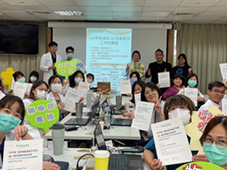
scenarios. Currently, our hospital has developed diverse teaching materials for
various job categories, such as:
l
Physician Version (PGY/Clerk): Training physicians on how to convey bad
news with empathy in scenarios such as explaining colorectal cancer cases
(Breaking Bad News) and interpreting adult health check reports.
l
Nursing Version: Simulating ISBAR handover scenarios to enhance the
accuracy of team communication.
l
Cross-Job Applications: Including scenarios such as medic
al radiologists
calming impatient patients, medical laboratory technicians handling patients
who faint from injections, pharmacists providing consultation on adverse drug
reactions, and even counseling psychologists communicating with families in
palliative care wards.
These
virtual lesson plans provide standardized and repeatable practice
opportunities. Based on the participants' dialogues, radar chart analyses
(e.g., empathy, professionalism, communication skills) are generated in real
time, providing specific improvement suggestions. This not only reduces the
burden on clinical teachers who need to repeatedly role-play standardized
patients (SPs), but also allows participants to engage in immersive practice
anytime, anywhere, effectively improving their communication skills.
IV.
Expansion of the Teaching Space: From VR to Immersive Classrooms – A
Virtual-Real Integration
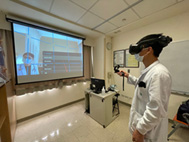
Since the introduction of VR
equipment in 2021, usage has increased from 54 users to 557 users in 2024, demonstrating
a significant improvement in clinical teaching acceptance. VR allows trainees
to immerse themselves in virtual operating rooms or emergency scenarios,
conducting highly realistic training in procedures such as tracheostomy care,
nasogastric tube insertion, and emergency procedures, breaking through time and
space limitations and safely recreating high-risk situations.
In the future, our hospital will
promote "immersive classrooms" and "Hybrid Simulation,"
combining simulation center equipment, wall projection, motion detection, and
multi-person experiences to create cross-professional team training
environments, enabling physicians, nurses, and medical staff to enhance
collaboration and communication in a clinically relevant environment.
V.
Conclusion: Technology Begins with Humanity, Ends with Patient Safety
Following the TPACK (Technology,
Subject, and Pedagogical Knowledge Integration) framework, our institute firmly
believes that technology is merely an aid to educational development; the core
lies in the integration of teaching content and methods. From traditional
lectures and blended learning to today's smart and immersive learning, our
teaching model continues to evolve.
In line with the national
"Healthy Taiwan Deep Cultivation Plan," we will continue to invest
resources in diverse talent training and the introduction of smart
technologies. Through Microsoft digital tools to optimize processes, Gen AI to
assist in knowledge construction, virtual humans to enhance communication, and future
immersive virtual-physical integrated environments, we are committed to
creating a "high-value" medical education system. All these
innovations ultimately point to one unchanging goal: to safeguard patient
safety, improve the quality of care, and cultivate medical professionals who
treat patients with compassion and possess both professional skills and ethical
integrity.
 Diverse Virtual Career Course Lesson Plans
Building "immersive classrooms" and promoting "virtual-real integrated teaching"