Specialties: Da Vinci-assisted minimally invasive lung and mediastinal surgery, 3D thoracoscopic minimally invasive surgery, lung diseases, mediastinal diseases, pectus excavatum, chest wall tumors, rib fracture reduction surgery, trauma, adjuvant cancer treatment
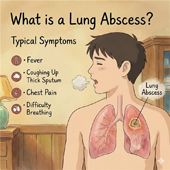
What Is a Lung Abscess?
A lung abscess is a serious lung
infection that forms a pocket filled with pus, dead tissue, and inflammation
inside the lung.
As this pocket grows, it can press on
healthy lung tissue and cause trouble breathing, chest pain, and large amounts of
phlegm.
On chest X-ray or CT scan, a lung abscess usually looks like a cavity with an
air–fluid level.
Lung abscesses have been known since
ancient times. Before antibiotics were available, many patients died from
uncontrolled infection. In the early 20th century, surgical drainage greatly
reduced death rates and changed how this disease was treated.
Why Does a Lung Abscess Happen?
A lung abscess may develop when:
·
Germs from the mouth or stomach are
accidentally breathed into the lungs
·
Severe pneumonia does not fully
heal
·
The immune system is weak
·
A foreign object is inhaled
·
A tumor, narrowed airway, or
poor blood flow prevents antibiotics from reaching the infection
When dead lung tissue cannot drain properly, bacteria can keep
growing and make the infection worse.
Common Symptoms
At first, symptoms may look like pneumonia, but they last longer and
gradually get worse.
Patients may have:
·
High fever and chills that keep coming back
·
Large amounts of thick, foul-smelling
phlegm, sometimes with blood
·
Chest pain or back pain, worse with deep breathing or coughing
·
Shortness of breath and extreme
tiredness
·
Poor appetite and weight loss
If the infection spreads to the chest cavity (empyema), patients may
need oxygen,
a breathing machine, or even intensive care due to septic shock.
Waiting too long can be dangerous — early treatment saves lives.
Treatment: From Medicine to Surgery
First Step: Antibiotics and Drainage
Most patients improve with:
·
Strong antibiotics
·
Drainage of pus (using imaging guidance or chest tubes if needed)
However, treatment may fail if:
·
The abscess is very large
·
Blood flow to the area is poor
·
Dead tissue blocks healing
When Is Surgery Needed?
Doctors may recommend surgery if:
·
Antibiotics and drainage do not
work
·
The abscess is larger than 6 cm and
still growing
·
There is empyema,
pneumothorax, or massive bleeding
·
The patient develops respiratory failure,
sepsis, or rapid worsening
·
Dead lung tissue keeps causing
repeated infection
Keeping badly damaged lung tissue can allow bacteria to hide and
cause repeated
infections and long hospital stays.
Today, most surgery is done using minimally invasive thoracoscopic
surgery (VATS), which means:
·
Smaller wounds
·
Less pain
·
Faster recovery
New Evidence: Surgery Can Save Lives
A 2025 study from our thoracic surgery team showed that in patients
whose lung abscess did not respond to medicine:
·
Removing the affected lung lobe
(lobectomy) reduced death from lung abscess by
about
50%
·
Thoracoscopic lobectomy was safe and effective
This shows that early surgery is better than waiting too long
when infection cannot be controlled.
Recommended Care Path
1.
Early diagnosis and timely
antibiotics
2.
Drainage if needed
3.
Early discussion with a
thoracic surgeon if the condition worsens
4.
Avoid waiting until sepsis or
respiratory failure develops
Key Message
A lung abscess is dangerous, but it is treatable.
Most patients recover with antibiotics and drainage.
For severe cases that do not improve, early minimally invasive surgery can save lives.
Understanding the disease and treatment options — and acting early —
is the key to survival and recovery.
References:
O Neuhof H, Hurwitt E. Acute putrid abscess of the lung: VII.
relationship of the technic of the one-stage operation to results. Ann Surg.
1943;118:656–64.
O Zhang JH, Yang SM, How CH, Ciou YF. Surgical management of lung
abscess: from open drainage to pulmonary resection. J Vis Surg. 2018;4:224
O Schweigert M, Solymosi N, Dubecz A, John J, West D, Boenisch PL, et
al. Predictors of outcome in modern surgery for lung abscess. Thorac Cardiovasc
Surg. 2017;65:535–41
O Su PK, Yang SM, How CH, Liu CY, Leong KL, Lin JK, Chou SF. Evaluating
the effectiveness of thoracoscopic intervention for pulmonary abscess: is
lobectomy the optimal solution after medical therapy fails? BMC Surgery 2025; 25:488-97