
Specialties:
Comprehensive Trauma Care and General Trauma Management; Chest Wall Trauma and Surgical Fixation of Rib Fractures; Minimally Invasive Thoracic Surgery for Lung Tumors, Pneumothorax, Empyema, and Lung Volume Reduction Surgery; Mediastinal Disorders, including Mediastinal Tumors, Infections, Foreign Bodies, Myasthenia Gravis, and Diaphragmatic Weakness or Hernia.
When major disasters, public safety incidents, or sudden mass-casualty
incidents (MCIs) occur, hospitals are often confronted with two simultaneous
challenges. On one hand, multiple patients with severe traumatic injuries
require immediate, life-saving intervention. On the other, the hospital itself
may experience functional degradation of surgical capacity, as operating
rooms, personnel, or equipment become constrained by overwhelming demand or
disaster-related disruption.
Ensuring that essential trauma surgical services can continue when
hospital capacity is compromised has become a defining responsibility of
modern medical centers.
In response to these risks, the Ministry of Health and Welfare has
promoted the Resilient Healthcare Program, emphasizing that medical
centers must maintain continuity of critical healthcare functions during
disasters or extraordinary conditions. Within this framework, the Backup Operation
Room Project (BORP) has been developed as a key strategy to preserve
emergency trauma surgical capability when standard systems are under stress.
Why Do We Need the Backup Operation
Room Project (BORP)?
During disasters or MCIs, hospital surgical capacity may be affected at
the same time that critically injured patients arrive. Operating rooms may be
unavailable due to space limitations, equipment damage, or staffing shortages,
yet trauma patients still require urgent interventions such as hemorrhage
control, decompression, or damage-control surgery. Reliance solely on
conventional operating rooms and routine workflows may therefore result in
dangerous delays during the most critical window for survival.
The Backup Operation Room Project (BORP) was established to
address this gap. When hospital surgical capacity is compromised, BORP enables
the extension of damage control surgical capability beyond conventional
operating rooms, allowing care to be delivered in non-conventional
medical spaces or austere environments that can be rapidly adapted for
emergency use. Within predefined safety boundaries, essential life-saving
procedures can be initiated without delay.
BORP is not intended to replace standard operating rooms. Rather, it
functions as a continuity-of-operations strategy, ensuring that
essential damage control surgery remain available when routine hospital
infrastructure cannot function fully. In this way, BORP represents the
hospital’s last line of defense for life-saving surgical care under disaster
conditions.
Modular Organization and Rapid
Mobilization Under BORP
Under BORP, Far Eastern Memorial Hospital employs a compact, modular
operational design. Each BORP unit consists of 10 members, including
trauma and orthopedic surgeons, emergency physicians, emergency nurses,
anesthesiologists or nurse anesthetists, operating room nurses, and logistics
support personnel. This structure allows for rapid mobilization and independent
execution of emergency trauma surgery when conventional operating rooms are
unavailable.
Currently, the hospital has established two fully operational BORP
units, with an additional three reserve units planned to support
surge capacity. Depending on the scale and duration of an incident, units may
be activated sequentially or rotated to sustain surgical capacity over time
while minimizing staff fatigue.
Dedicated Equipment as a Core
Component of BORP
BORP is not solely a staffing model; it is a system-level capability
supported by dedicated resources. With funding support from the Ministry of
Health and Welfare, Far Eastern Memorial Hospital has established exclusive
BORP equipment sets, including trauma surgical instrument kits, hemorrhage
control and fixation devices, surgical lighting, power saws, and essential
surgical and anesthesia supplies. These resources are not shared with routine
surgical services, preventing competition for equipment during emergencies.
All BORP equipment is managed through an electronic tracking system that
monitors expiration dates, sterilization status, and replenishment processes.
This ensures that equipment is immediately deployable when needed—not merely
listed on paper.
Emphasizing Training, Team-Based
Coordination, and Advanced Trauma Capability
Effective disaster response depends not only on individual technical
expertise, but on system performance under pressure. Training within
BORP therefore places strong emphasis on team-based coordination and the
development of advanced trauma capability.
Team training is structured around trauma resource management (TRM)
principles, focusing on clear role definition, closed-loop communication, and
mutual support in environments where time, manpower, and resources are limited.
Through competency-based courses, scenario-driven simulations, and field
exercises—including training conducted in non-conventional spaces such as
underground parking areas—participants learn to maintain shared situational
awareness and coordinated action under high stress.
In parallel, Far Eastern Memorial Hospital places strong emphasis on the long-term
development of physicians’ advanced trauma surgical skills. Surgeons
involved in BORP are systematically supported to complete internationally
recognized training programs such as ASSET (Advanced Surgical Skills for
Exposure in Trauma) and DSTC (Definitive Surgical Trauma Care).
These programs focus on life-saving operative techniques, rapid hemorrhage
control, and critical surgical decision-making—competencies essential for
disaster settings and austere surgical environments.
By integrating team-based coordination with advanced trauma expertise,
BORP represents not merely a policy framework, but a deployable surgical
capability—one that can adapt to compromised infrastructure while
maintaining patient safety and clinical effectiveness.
An Investment in Life
The Backup Surgical Room Project (BORP) represents Far Eastern Memorial
Hospital’s long-term commitment to public safety. This initiative is not simply
an investment in equipment or manpower, but a deliberate choice to invest in
the capacity to save lives at critical moments.
Looking ahead, the hospital will continue to integrate BORP with its
emergency response systems, including the Doctor-in-Car (physician-staffed
rapid response vehicle). This allows physicians to assess injuries earlier
at the scene, initiate clinical decision-making sooner, and activate
in-hospital surgical resources in advance—reducing the time from injury to
definitive trauma care.
In an era defined by uncertainty, Far Eastern Memorial Hospital stands
firm as a critical pillar of emergency and disaster care. Through the Backup
Surgical Room Project (BORP), the hospital ensures that when people need help
the most, surgical capability remains available—protecting every precious life.
Author Information
Hu-Lin
Christina Wang, MD, MSc
Ward Director, Division of Trauma, Far Eastern Memorial Hospital
Executive Lead, Backup Surgical Room Project (BORP)
Deputy Secretary General, Formosa Association for the Surgery of Trauma (FAST)
Joint Lecturer, Yuan Ze University, Department of Computer Science and
Engineering
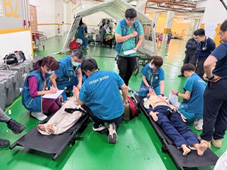
Picture 1: Triage and assessment of wounded patients during BORP drill
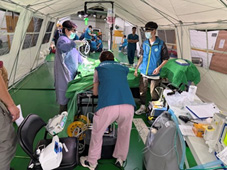
Picture 2: Damage control surgery in a medical tent set
up during BORP drill
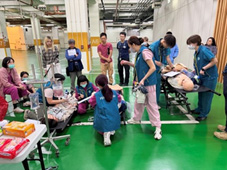
Picture 3: Postoperative
care during BORP drill