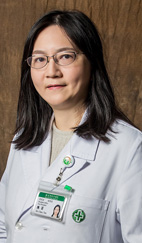
Specialties: Pediatric hernia, cryptorchidism, balanitis, pediatric gastrointestinal and hepatobiliary surgeries, pediatric chest deformities, pectus excavatum, pigeon chest, pediatric urinary system surgeries, reconstructive surgery for neonatal congenital malformations, frenulum repair, subcutaneous tumor repair, torticollis and other minor outpatient surgeries, small bowel transplantation and intestinal failure reconstruction.
For most people, eating is part of everyday
life. Yet for patients with intestinal failure, “being able to eat” may be the
most distant and precious wish.
Over the years, I have cared for children
who lost most of their small intestine shortly after birth because of severe
intestinal disease. From a very young age, their lives became inseparable from
intravenous lines, central venous catheters, and total parenteral nutrition.
While other children were learning to eat, go to school, and run freely, these
children often had their lives interrupted by catheter-related infections,
fever, and repeated hospitalizations. For their families, every fever felt like
an alarm. Every problem with a central venous catheter could mean that one more
lifeline had been lost.
Intestinal failure is still not well
understood by the general public. These patients do not simply have a “poor
digestive system.” Their small intestine can no longer absorb enough nutrients,
water, and electrolytes to sustain life. They must rely on total parenteral
nutrition to survive. Total parenteral nutrition has saved many lives, but
long-term dependence may also lead to recurrent catheter-related bloodstream
infections, liver injury, loss of venous access, nutritional and metabolic
problems, and a heavy burden on daily life. When these complications occur
repeatedly, intestinal transplantation may become an important treatment option
for high-risk patients to regain a chance at life.
Gratitude Behind the Gift of
Transplantation
Every May, Far Eastern Memorial Hospital
holds its Thanksgiving and Memorial event for organ donation. When we speak
about organ transplantation, the first feeling that comes to mind is gratitude.
We are grateful to deceased organ donors
and their families, who, at the most difficult moment of life, chose to leave
hope for others. The development of intestinal transplantation in Taiwan has
been made possible by many quiet and selfless contributions: the trust of
patients and families, the generosity of donor families, and the long-term
dedication of medical teams who refused to give up.
Far Eastern Memorial Hospital has been
devoted to intestinal transplantation and intestinal failure care for more than
20 years. From the early establishment of our intestinal failure care team, to
the completion of deceased donor intestinal transplantation, the founding of
our Intestinal Failure Care Center, and the gradual development of central
venous catheter care, infection control, nutritional support, intestinal
rehabilitation, immune monitoring, and long-term follow-up, we have learned one
thing very clearly: intestinal transplantation is never the victory of a single
operation. It is the result of a complete system of care.
Not One Operation, but a Complete Care
System
The small intestine is an important immune
organ. After transplantation, the risks of rejection and infection are high,
and postoperative care is extremely complex. Whether a patient can do well in
the long term depends not only on the surgery itself, but also on precise
pre-transplant evaluation, control of catheter-related infections,
reconstruction of nutrition, early detection of rejection, and whether the
family can continue safe care after the patient returns home.
For this reason, the intestinal
transplantation team at Far Eastern Memorial Hospital has never been a
single-department team. It is a multidisciplinary team involving surgery,
pediatric surgery, gastroenterology and hepatology, cardiovascular surgery,
infectious diseases, intensive care, anesthesiology, nursing and dedicated ward
care, nutrition, pharmacy, laboratory medicine, pathology, radiology,
psychiatry, social work, and case management.
This is also why we place such strong
emphasis on quality. Quality is not a slogan. It is found in the details we
carry out every day in the ward: whether catheter care is standardized, whether
infection rates are reduced, whether central venous access is preserved,
whether nutritional prescriptions are individualized, whether patients can be
followed after discharge, and whether families have someone to turn to when
problems arise.
For patients with intestinal failure,
quality is not merely a number on a report. It means one fewer infection, one
fewer emergency visit, one more usable vein, and one more stable day at home.
Turning High-Risk Medicine into
Sustainable Care Through 20 Years of Accumulation
In recent years, Far Eastern Memorial
Hospital has achieved important results in intestinal transplantation. From
2007 to 2024, our hospital completed 38 cases of intestinal transplantation.
The overall patient survival rates at 1, 3, and 5 years were 78.9%, 73.7%, and
71.1%, respectively. Looking at more recent outcomes from 2011 to 2024, the
1-year survival rate improved to 81.8%, and the 3- and 5-year survival rates
both reached 75.8%.
These numbers represent more than surgical
maturity. They reflect the gradual stabilization of team-based care, continued
improvement in infection control, and the strengthening of postoperative
monitoring and long-term follow-up. Behind every percentage is a patient, a
family, and countless multidisciplinary discussions, bedside decisions,
discharge plans, and follow-up efforts.
Living Donor Intestinal Transplantation:
Opening Another Door for Patients Who Cannot Wait
Despite these advances, the availability of
deceased donor organs remains limited. Children and smaller patients often face
even greater challenges while waiting for a suitable organ. Some may lose the
chance for transplantation before a suitable graft becomes available, because
of recurrent infection, worsening liver function, or exhaustion of central
venous access.
This is why Far Eastern Memorial Hospital
initiated a clinical trial of living donor intestinal transplantation. Our goal
was to open another door for high-risk patients with intestinal failure, under
strict medical, ethical, and donor safety evaluation.
The meaning of living donor intestinal
transplantation is not to romanticize the sacrifice of family members. Rather,
it is a relay of love and professional responsibility, carried out under a protected
and carefully regulated medical system. Every donor must undergo complete
physical evaluation, 3D vascular and intestinal anatomical assessment,
psychiatric and social work evaluation, and review by the medical ethics
committee. For us, the rebirth of the recipient is important, but the safety
and recovery of the donor are equally important.
Far Eastern Memorial Hospital has now
completed 3 cases of living related intestinal transplantation, including one
between sisters and two in which mothers donated to their children. Among these
cases were children who had long depended on total parenteral nutrition,
families who traveled across borders seeking care, and mothers who, after a
long journey of caregiving, finally saw the possibility that their child might
learn how to eat.
When one mother said, “I just hope my child
can know what it feels like to eat,” we all understood that this was not only
an operation. It was a family’s long-awaited wish for ordinary life.
Approval of Clinical Trial Closure by the
Ministry of Health and Welfare: A Milestone and a New Beginning
We are grateful that our clinical trial of
living donor intestinal transplantation has been approved for closure by the
Ministry of Health and Welfare. For our team, this represents an important
milestone. It shows that we have completed a full stage of validation in
surgical technique, donor safety, recipient care, ethical review, and long-term
follow-up.
Our hospital has also further submitted an
application to the Ministry of Health and Welfare to have living donor
intestinal transplantation recognized as a routine medical treatment. We hope
that, after review and approval by the competent authority, eligible high-risk
patients with intestinal failure may have access to a more timely and safe
treatment option.
Intestinal transplantation is a difficult
path. There is no single hero. There is only a team working together to
complete every step well. From catheter care to nutritional reconstruction,
from transplant surgery to post-discharge follow-up, from patient safety to
quality of life, every step requires both quality management and clinical
warmth.
We are not merely performing highly complex
surgery. We are building a sustainable model of care: one that can care for
patients, support families, protect living donors, and continue to improve.
Looking back on these 20 years during this
month of gratitude, what I feel most deeply is still thankfulness. I am
grateful to our patients, who have taught us humility. I am grateful to
families, who have taught us what it means not to give up. I am grateful to
donors, whose generosity allows life to continue. I am also grateful to every
colleague at Far Eastern Memorial Hospital who has stood at the frontline to
protect these patients.
For patients with intestinal failure,
rebirth does not always begin with something dramatic. Sometimes it begins with
the first sip of water, the first bite of food, or the first night of sleep
without being connected to an intravenous line.
May we continue to work hard so that more
patients can not only survive, but also return to their families, schools,
workplaces, and lives. May the simple act of “being able to eat” once again
become the most grounded happiness in their lives.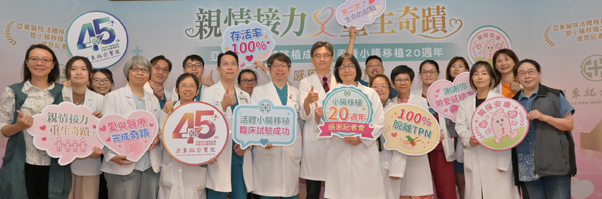
Far Eastern Memorial Hospital has been dedicated to small intestine transplantation for 20 years, completing 38 cases of selfless donation. On May 7, 2026, they successfully performed the first "living small intestine" transplant in Taiwan.
Gan's younger brother successfully recovered after undergoing a living small intestine transplant in Taiwan. He posed for a photo with his mother and Vice President Chen Yun, and expressed his gratitude to the medical team.