
Specialties:
-
Image-Guided Helical TomoTherapy (TomoTherapy)
-
Stereotactic Body Radiation Therapy (SBRT)
-
Stereotactic Radiosurgery (SRS)
-
Genitourinary cancers: prostate cancer and bladder cancer
-
Colorectal cancer
-
Lymphoma
-
Brain tumors
-
Bone metastases
-
Brain metastases
-
Postoperative radiotherapy for keloids
-
Radiotherapy for degenerative osteoarthritis
For patients with prostate cancer,
achieving the optimal balance between "complete tumor eradication"
and "preserving quality of life" has long been a central focus of
outpatient consultations. Historically, patients had to choose among
challenging options: undergoing prolonged conventional radiotherapy that
required frequent hospital visits over two months, facing the anesthesia risks
and substantial out-of-pocket expenses associated with radical surgery, or
bearing the hefty self-paid costs of advanced stereotactic radiotherapy.
Today, a major breakthrough has resolved
this clinical dilemma. Taiwan’s National Health Insurance Administration (NHIA)
officially announced that, effective April 1, 2026, precise Stereotactic Body
Radiotherapy (SBRT) is included under National Health Insurance (NHI) coverage,
with newly approved indications for low- and intermediate-risk prostate cancer.
Eligible patients can now receive an internationally standardized,
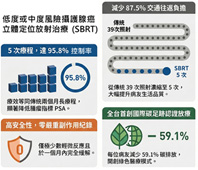
ultrahypofractionated precision radiotherapy requiring only five treatment sessions.
This milestone policy spares patients from previous out-of-pocket costs
exceeding NT$200,000, bringing immense relief and benefit to both patients and
their families.
International Evidence and FEMH’s
Clinical Experience Confirm Safety and Efficacy
The foundation of this new reimbursement
policy rests primarily on the five-year follow-up results of the PACE-B trial
published in 2024. This landmark study demonstrated that SBRT, delivered in
just five sessions, achieved an outstanding biochemical recurrence-free
survival rate of 95.8%. Its curative efficacy and disease control were proven
comparable to conventional long-course radiotherapy lasting nearly two months.
In addition to robust international
evidence, local clinical experience in Taiwan has yielded equally encouraging
outcomes. Since 2024, the Department of Radiation Oncology at Far Eastern
Memorial Hospital (FEMH) has actively implemented SBRT for prostate cancer,
accumulating successful treatment experience with more than 100 patients. These
clinical findings were presented at the 2025 Taiwan Joint Cancer Conference,
receiving high acclaim from the medical community. Preliminary follow-up
results demonstrated:
- Excellent treatment efficacy: All
patients experienced significant and sustained declines in
prostate-specific antigen (PSA) levels during follow-up, indicating highly
effective tumor control.
- Outstanding safety profile: No
patients experienced Grade 3 or higher severe adverse events during
treatment, and none required treatment interruption due to intolerance.
- Rapid resolution of acute side effects: Only a small fraction of patients (approximately 4.3%)
developed Grade 2 acute urinary or rectal symptoms—such as urinary
frequency, nocturia, or mild dysuria—during treatment. Most of these symptoms
resolved completely within two weeks to one month post-therapy, leaving no
long-term sequelae.
A New Era of Green Healthcare: Taiwan’s
First Carbon-Footprint-Certified Ultrahypofractionated Radiotherapy Course
While pursuing frontiers in precision medicine,
FEMH has also pioneered the integration of environmental sustainability into
clinical practice. Conventional radiotherapy for prostate cancer typically
spans approximately eight weeks, requiring patients to commute to the hospital
for up to 39 sessions. This results in substantial transportation-related
carbon emissions and high energy consumption from prolonged medical equipment
operation.
Through SBRT technology, the treatment
course is condensed into just five sessions. This not only significantly eases
the burden of repetitive hospital visits for patients but also reduces
commuting frequency by 87.5%, establishing a landmark model for low-carbon
radiotherapy.
- International carbon-footprint certification: This innovative radiotherapy model has received third-party
carbon-footprint certification from an internationally recognized
organization, making FEMH a pioneer in Taiwan’s low-carbon oncology field.
These research findings were also accepted for poster presentation at the
American Society for Radiation Oncology Annual Meeting.
- Remarkable, measurable carbon reduction: Compared with conventional radiotherapy, SBRT reduces the
carbon emissions associated with each patient's treatment by 59.1%. In
2025 alone, the 81 completed treatment courses at FEMH collectively
reduced carbon emissions by 4,203.9 kg, successfully aligning high-quality
clinical care with environmental sustainability.
Forward-Looking Academic Perspectives
and the Vital Importance of Early Screening
 Although current NHI coverage is primarily
designated for low- and intermediate-risk patients, several landmark
international trials—including PACE-C, PACE NODES, and STAMPEDE—alongside
clinical evidence from FEMH, suggest that SBRT also delivers favorable local
control and safety for patients with high-risk disease, lymph node metastases,
or distant metastases. While these advanced indications are not yet fully
covered by NHI, patients are encouraged to discuss integrated, personalized
treatment planning with their medical teams alongside standard therapies.
Although current NHI coverage is primarily
designated for low- and intermediate-risk patients, several landmark
international trials—including PACE-C, PACE NODES, and STAMPEDE—alongside
clinical evidence from FEMH, suggest that SBRT also delivers favorable local
control and safety for patients with high-risk disease, lymph node metastases,
or distant metastases. While these advanced indications are not yet fully
covered by NHI, patients are encouraged to discuss integrated, personalized
treatment planning with their medical teams alongside standard therapies.
These clinical developments further
underscore the importance of "early screening and early diagnosis."
Detecting prostate cancer at a low- or intermediate-risk stage not only
optimizes treatment outcomes and long-term prognosis, but also enables patients
to qualify for NHI coverage, drastically reducing their financial burden. Men
aged 50 years or older, or those aged 45 years or older with a family history
of prostate cancer, are strongly encouraged to undergo annual PSA blood testing
and digital rectal examinations by a urologist.
For patients diagnosed with prostate
cancer, the clinical team at FEMH—backed by NHI reimbursement and a proven
track record of over 100 successful cases—stands ready to provide a safe,
noninvasive, and anesthesia-free precision treatment option that minimizes
disruption to daily life and work. Patients are welcome to visit the Department
of Radiation Oncology at FEMH for a comprehensive evaluation and professional
consultation.