
Specialties: Cancer counseling for various types of tumors, radiotherapy and palliative care, guided spiral knife, stereotactic body radiotherapy (SBRT), stereotactic radiosurgery (SRS), prostate cancer, bladder cancer, colorectal cancer, lymphoma, brain tumor, bone metastasis, brain metastasis, postoperative radiotherapy for keloids, and osteoarthritis.
Joint Pain: A Warning Sign and a Vicious Cycle
With increasing life expectancy,
osteoarthritis has become a common condition affecting the quality of life
among middle-aged and older adults. The core problem lies in the chronic
inflammatory response triggered by cartilage degeneration, leading to
persistent swelling, stiffness, and pain that significantly limit mobility.
However, traditional treatments often reach a
bottleneck. Long-term use of oral medications (such as NSAIDs) carries risks of
side effects; intra-articular injections offer only temporary relief and may
accelerate cartilage wear if steroids are used repeatedly; joint replacement
surgery is effective but invasive, and some patients are not suitable
candidates. At this therapeutic gap, low-dose radiotherapy (LDRT)—a
non-invasive treatment targeting the source of inflammation—has gained
significant attention in the international medical community.
The Science Behind LDRT: Modulating
Inflammation Rather Than Killing Cells
When applied to osteoarthritis, the purpose of
LDRT is functional regulation, not tissue destruction. Unlike the 60–80
Gy typically used in cancer radiotherapy, the total dose for LDRT is only about
3 Gy, representing a tiny fraction of cancer-treatment doses. This makes
LDRT a highly safe treatment without structural cell damage or typical
high-dose skin reactions.
LDRT works by suppressing the proliferation
and activity of overly activated inflammatory cells in the joint space—such as
macrophages and lymphocytes—and by regulating pro-inflammatory cytokines. By
rebalancing the abnormal inflammatory environment, LDRT shifts the joint
condition from ongoing destruction to calm stability, thereby
reducing swelling and pain and providing long-lasting relief.
A Precise and Standardized Treatment Process
LDRT is a highly standardized outpatient
treatment—fast, painless, and with no impact on daily life. The process
consists of a clinical evaluation, followed by CT-based simulation using
immobilization devices, and the creation of a treatment plan that precisely
targets the inflamed region. Treatment is administered three times per week for
a total of six sessions and is typically completed within two weeks.
International Evidence and Implementation at
Far Eastern Memorial Hospital
LDRT’s clinical effectiveness is well
established. The German Society for Radiation Oncology recognizes LDRT as a
standard option for mild to moderate osteoarthritis and specifies a safe dose
range of 3.0 to 6.0 Gy. The Korean LoRD-KNeA clinical trial further
confirmed its efficacy: patients receiving 3 Gy achieved a 70% pain response
rate at four months—significantly higher than the control group. These
international studies verify LDRT’s low risk and substantial benefit.
At Far Eastern Memorial Hospital, the
Radiation Oncology Department has incorporated LDRT based on the latest
research and guidelines. Our clinical experience shows that, under rigorous
treatment standards (Table 1), patients experience approximately 70%
improvement in pain scores, with no significant side effects—closely
mirroring the results of large international trials.
Table
1. Recommended Eligibility Criteria for LDRT in Osteoarthritis
|
Category
|
Criteria
|
Notes
|
|
Age
|
? 65 years
|
Extremely
low secondary cancer risk
|
|
Diagnosis
|
Primary
osteoarthritis
|
Supported by
clinical evidence
|
|
Imaging
Severity
|
Kellgren–Lawrence
grade 2 or 3
|
X-ray
confirmation required
|
|
Pain Level
|
VAS score
50–90
|
Moderate to
severe pain
|
|
Conservative
Therapy
|
? 6 months
with inadequate improvement
|
Requires
documentation
|
|
Recent
Injections
|
No
intra-articular injections within 2 months
|
Avoid
treatment interference
|
A Commitment to Efficacy and Safety
Studies show LDRT provides an effective
response in roughly 70% of patients, with benefits typically lasting six
months or longer. Short-term side effects are rare and mild. Most
importantly, long-term data confirm no increased risk of secondary cancer
when using the recommended very low doses. For older adults (especially those
with multiple comorbidities who are poor surgical candidates), the benefits far
outweigh the minimal theoretical risks.
We encourage patients suffering from chronic
joint pain who have not responded well to conventional treatments to consult
the Radiation Oncology Division at Far Eastern Memorial Hospital. Together, we
can evaluate whether LDRT may help you regain long-lasting inflammatory control
and enjoy the freedom of movement again.
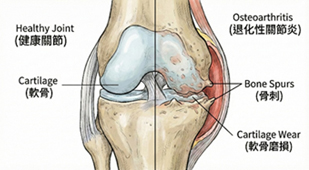 Diagram of osteoarthritis
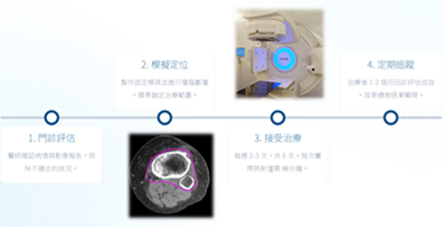
Low-dose radiotherapy (LDRT) procedure